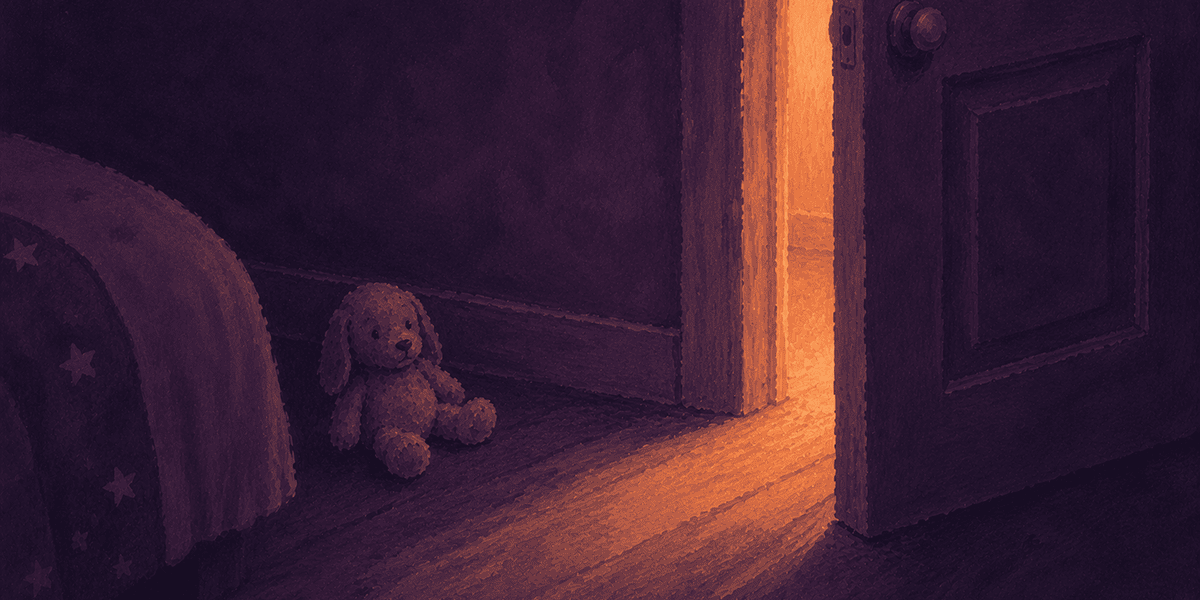
Bedtime fears typically emerge between ages three and four, peak around five, and ease by seven or eight. The fears are a side effect of the imagination growing, the same skill that builds theory of mind. Telling a child there is nothing there usually escalates the fear. Naming the fear and adding structure works better than arguing with it.
Somewhere between age three and age six, a lot of children develop bedtime fears. Specifically. Suddenly. Fully formed. The four year old who slept fine for two years is now refusing to be in the dark without a parent. The cupboard is suspicious. The shadow on the wall is a wolf.
This is not a parenting problem. It is a developmental milestone, which is one of the things parents are rarely told about it. Here is what is actually happening and why "there is nothing there" almost never works.
When the fears arrive, and why
Children's bedtime fears typically begin between age three and age four and peak around age five. They tend to ease by age seven or eight, though some echo into early adolescence in a different form.
The reason they show up at that age is cognitive, not behavioural. Between three and five, a child's brain is building what developmental psychologists call theory of mind: the understanding that other people have inner lives, intentions, and that those intentions are not always visible. This is the same skill that makes stories work, and it is the same skill that makes monsters possible. If you can imagine a friend with feelings you cannot see, you can also imagine a stranger with feelings you cannot see. The bedroom is suddenly populated.
The imagination is not the problem. The imagination is the milestone. The fear is the cost of that milestone.
Why "there's nothing there" makes it worse
The first parent move is almost always logical. "There is nothing there. Look, see, I am opening the cupboard. Empty." It is calm. It is true. It does not work.
Two things are happening when this fails.
The first is that the child's brain has just registered a threat. The amygdala, the part of the brain that handles fear, does not care whether the threat is logical. It cares whether the body is activated. Once the body is activated, evidence has very little reach. Telling a child "there is nothing there" while their cortisol is up is like telling an adult with vertigo "the floor is not moving". True, irrelevant, unhelpful.
The second is that "there is nothing there" reads, to a small child, as "your perception is wrong". This adds a second layer of unsafety: the parent does not believe me, and now I am also alone. The parent intended to reassure. The child experienced isolation.
What works is the opposite. Acknowledge the perception, then provide structure.
What helps, framed gently
Across the parents we have talked to, four patterns keep coming up for bedtime fears in the three to six age range.
- Name the fear with them. "You are worried there is something in the cupboard." Not as a question. As an observation. Naming the fear shows the child their perception is taken seriously and gives the feeling somewhere to sit.
- Add structure, not evidence. A nightlight in a specific corner. A specific phrase as the parent leaves. A specific transitional object the child holds. The brain settles around predictable structure, not around argument.
- Externalise. The "monster spray" trick (a spray bottle of water labeled by the parent) sounds silly. It works for a lot of children at the four to five age. The mechanism is not magic. It is giving the child a small piece of agency over the fear, which is what they actually lack at bedtime.
- Hold the routine through it. Do not collapse the bedtime structure to accommodate the fear. Same time, same sequence, same goodnight. The structure is what tells the body the world is still safe. We have written about why structure matters in more detail.
When to take it more seriously
Bedtime fears are normal. Most resolve within months. A small percentage do not, and the difference matters.
Signs that a bedtime fear has crossed into something to flag with a paediatrician or family doctor:
- The fear has been present at intense levels for more than three to four months without easing
- The fear shows up during the day as well, not only at night
- The fear interferes with school, social functioning, or appetite
- The fear is accompanied by panic-level physical symptoms (racing heart, shaking, vomiting)
- The child is older than seven or eight and the fear is escalating rather than fading
None of those are emergencies. They are signals to mention it at the next check-in. Most bedtime fears never get there.
The thing nobody tells you
A child who is afraid at bedtime is not regressing. They are growing into a brain that can imagine things, which is the same brain that will read novels, do empathy, and tell their own stories one day. The fear and the imagination are the same machinery.
The job at bedtime, during the fear years, is not to remove the fear. It is to hold the room steady enough that the imagination has somewhere safe to do its work. Stories help. Routine helps. The parent's calm helps even when it does not feel like it is helping.
This is part of the problem we have been quietly working on. The bedtime story is one of the few moments where the imagination can be directed somewhere good before the lights go out. Follow along on Instagram.
If you want to read more first: why bedtime feels harder than the rest of the day covers the parent-side of the same hour.
The fear years end. Most kids will not remember they had them. The parents will.